HOME / AGENTS
Connected Manufacturing Agents
Governed AI Agents for Regulated Manufacturing
Secure data. Role-based access. Human-in-the-loop by design.
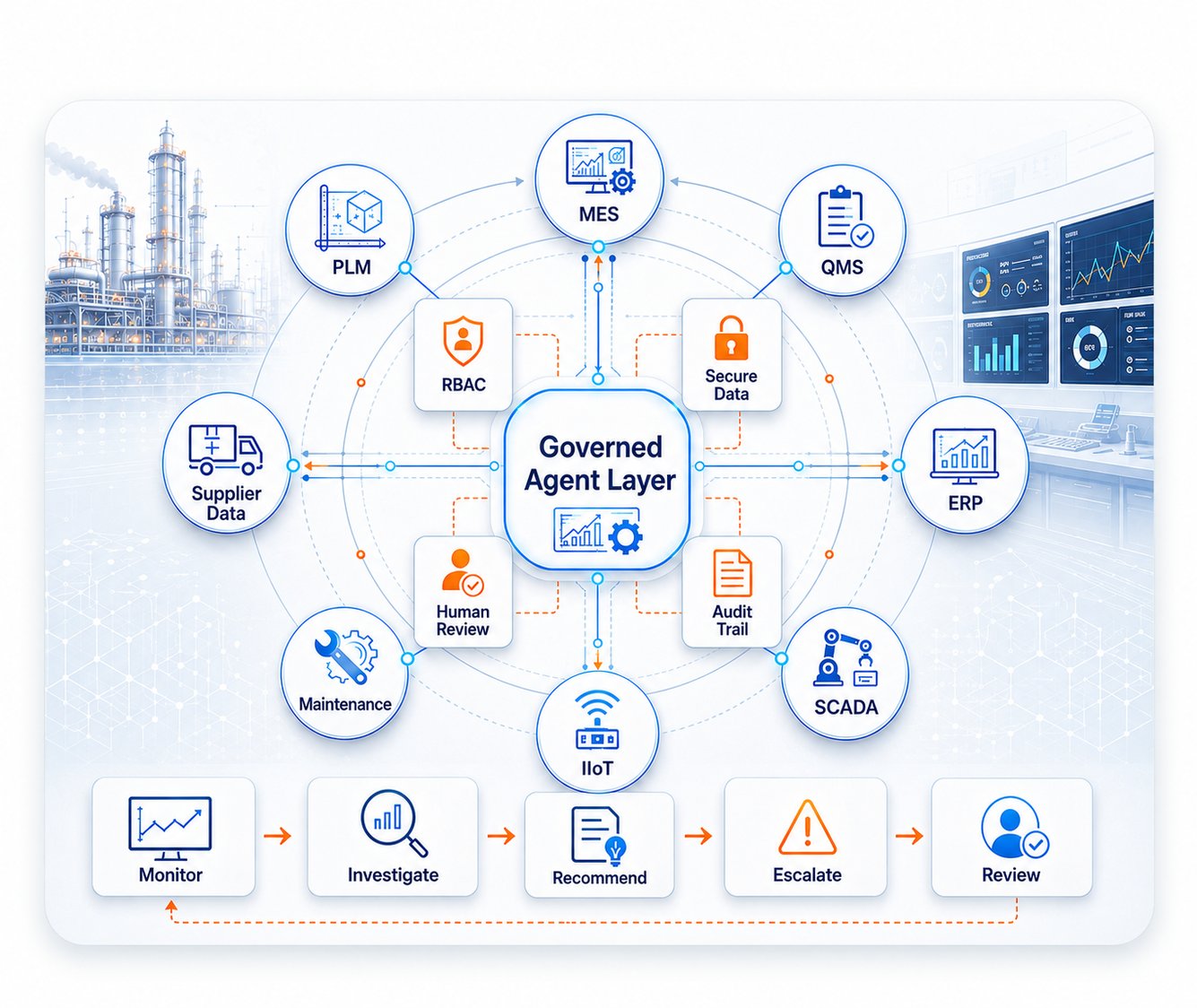
They are designed around secure customer data access, role-based permissions, auditability, and Annex 22-aligned human-in-the-loop.
Customer Data Security
Annex 22-Aligned Human-in-the-Loop
The Category
Regulated manufacturers need governed agents, not generic autonomy.
Connected Manufacturing Agents are built for practical plant workflows with defined roles, approved data sources, permission-aware access, evidence trails, escalation rules, and human review points.
Bounded by workflow
Bounded by data access
Bounded by accountability
Design Partner Program
Join our 90-Day Design Partner Program.
Design partners work with us on one focused, high-value use case such as quality investigation, root cause analysis, yield loss, downtime, maintenance intelligence, or compliance evidence gathering.
This is not an open-ended AI experiment. It is a 90-day, thin-slice program built around a defined workflow, approved data sources, role-based access, human review checkpoints, and measurable value.
From Conversational AI to the Agentic Application
Conversational AI answers questions. Agents coordinate governed action.
For regulated industries, that difference matters. The agent is not just producing an answer. It is helping coordinate a workflow across quality, production, maintenance, engineering, compliance, and management while respecting data access and human review requirements.
Conversational AI
- Ask questions in plain English
- Retrieve data across systems
- Return answers, charts, and summaries
- Reduce reporting and dashboard delays
- Help teams understand what happened
Governed Agentic Application
- Monitor changing conditions
- Investigate causes across systems
- Gather and preserve evidence
- Respect role-based access controls
- Recommend next-best actions
- Escalate decisions to qualified humans
- Support auditability and review
Secure data. Role-based access. Human-in-the-loop by design.
Closed-Loop Orchestration
Agents work across Design, Execute, Measure, and Improve.
They help move work from signal to evidence, from evidence to recommendation, and from recommendation to governed human action.
Functional Areas
Start where the business pain is visible.
The first generation focuses on areas where data is scattered, investigations are slow, and decisions require evidence.
Quality
Yield
Maintenance
Downtime
Root Cause Support
Governed routines
Turn a useful investigation into a governed, repeatable routine.
Connected Manufacturing provides one governed agentic application—not a collection of named digital workers.
Authorized users ask focused manufacturing questions across approved systems and documents. The application returns a source-backed answer with evidence, context, and recommended next checks.
When an analysis is useful, the user can save it as a governed routine, run it again when needed, schedule it, share it with authorized colleagues, and monitor its results through alerts, approvals, and review queues.
The same application can support routines across quality, yield, maintenance, downtime, operations, and root cause analysis.
Example Routine 1
Quality Evidence Review
Purpose
Help a quality team identify rising defect patterns and prepare the evidence needed for human review.
Example question
“What defects increased in the last 24 hours, which lots were affected, and what changed before the increase?”
What the application prepares
- Ranked defect changes by line, product, lot, shift, and time window
- Inspection and nonconformance records
- Related maintenance, process, supplier, and downtime signals
- Missing, stale, or conflicting evidence
- Recommended containment or inspection checks
Save as a routine
The quality engineer can save the successful analysis to run each shift, each day, or when a defined threshold is reached.
Governance model
The routine uses approved data sources and role-based access. A qualified quality owner reviews the evidence and remains responsible for containment, disposition, deviation, or escalation decisions.
Example Routine 2
Cross-System Root Cause Investigation
Purpose
Help a cross-functional team assemble evidence and develop testable root-cause hypotheses.
Example question
“Investigate the defect spike on Line 3 and show what changed across quality, yield, maintenance, downtime, and supplier data.”
What the application prepares
- A timeline of relevant events and changes
- Quality, yield, maintenance, tooling, downtime, and supplier evidence
- Ranked hypotheses with supporting and conflicting evidence
- Open questions and missing records
- Recommended validation steps and responsible functions
Save and share as a routine
The user can save the investigation pattern and share it with authorized quality, operations, maintenance, or engineering colleagues. The routine can then be reused for similar events without recreating the analysis from scratch.
Governance model
The application prepares evidence and recommendations. Qualified people determine the root cause, approve corrective actions, and remain responsible for regulated and operational decisions.
-
01
Ask
Ask a bounded manufacturing question.
-
02
Answer
Receive a visual, interpretation, and linked supporting evidence.
-
03
Save
Save useful work as a governed, repeatable routine.
-
04
Run
Execute the routine on demand or on an approved schedule.
-
05
Share
Make the routine available to authorized users and roles.
-
06
Monitor
Receive results, alerts, exceptions, and approval requests.
-
07
Review
Use the output within existing human-owned operational and regulated processes.
Operating principle
Self-service routine creation.
Governed application execution.
Human-owned decisions.
Governance
Governed means secure data, role-based access, and human accountability.
Agents assist the work. They do not silently replace human judgment in regulated workflows.
Role-based access control
Customer data security
Annex 22-aligned human-in-the-loop
Evidence trail
Auditability
Performance monitoring
90-Day Design Partner Program
Help shape governed manufacturing agents around a real operating constraint.
The program is designed for manufacturers that want to explore governed agents using real workflows, real systems, secure data access, role-based permissions, human review, and measurable business outcomes.
The right first use case is usually narrow and valuable: one recurring defect family, one downtime pattern, one yield issue, one root-cause workflow, or one compliance evidence bottleneck.
Program structure
Weeks 1–2
Select the constraint
Weeks 3–5
Connect the evidence
relevant systems.
Map role-based access rules, data security requirements, and permitted retrieval paths.
Weeks 6–8
Configure the Governed Application and Routine Controls
Weeks 9–12
Validate, launch, and measure
Who should apply
Good fit
- Regulated or quality-sensitive manufacturer
- Clear operating pain in quality, yield, maintenance, downtime, root cause, or compliance evidence
- Access to relevant system data
- Business owner willing to participate
- Need for governed AI, not uncontrolled automation
- Ability to support a 90-day pilot
- Willingness to define human review and accountability
Not the right fit yet
- No clear use case
- No access to source system data
- Looking for fully autonomous decision-making
- No internal owner for review and adoption
- Not ready to evaluate value within 90 days
- No ability to define access permissions or review roles
Design Partner Program